Sunday, February 13, 2022

Lessons from David Copperfield

David Copperfield, the somewhat autobiographical work by Charles Dickens, was published serially in 1849 and 1850.  It was his favorite novel that he authored and I wonder if he purposely inverted his initials to create David’s name as a nod to their commonalities.  Narrated in first person, David describes his life from the night of his birth until his adulthood.  There is a wide cast of characters, many of whom appear and reappear during various stages of David’s maturity.  It is at times a tragic story; other moments are hilarious.    


David’s life passes through distinct periods: his happy, early childhood; abuse at the hand of his strict stepfather; a period of time in Salem House, a boy’s boarding school; laboring in a factory in London; studying and then working as a legal proctor; eventually, getting married and embarking on a writing career.  As the reader, we see his progress from a naïve little boy to a wise adult; from someone whose heart acts impulsively to one who is discerning.  Yet, through these developments, challenges, and setbacks, David still manages to maintain his innocent goodwill and kindness.  


David’s life, as is the case with any of our lives, intersects with a myriad of people.  He meets many individuals along the way, some of whom have a major impact on his life’s course and his formation, while others merely pass through without leaving an impression on him.


What is curious, however, is the “coincidental” reemergence of characters throughout the novel.  For example, while working in the London factory, David has a kind landlord named Wilkins Micawber.  They part ways, Micawber and his family moving to Plymouth.  Yet, later on in the novel, Dickens is in Canterbury, visiting an acquaintance’s home.  Who should happen to pass by the open door and spot him?  Micawber, of course!  


This is but one example of many where various people from David’s life pop up—running into each other, spotting someone at a social gathering, reading in the newspaper about a teacher from his childhood.  On the one hand, this makes for an engaging plot where the characters interweave and interact in creative ways.  At the end of the novel, Dickens leaves the reader with a strong sense of closure, with all of the characters having clear, set endings.  There are no loose ends here.


Yet, I couldn’t help but reflect to myself that, unlike this novel, life is just very messy sometimes.  I consider people in my life: classmates I knew as a child, teachers I had in school, friends from college, even family members … individuals who crossed paths with me and for a while, we walked this life together: sharing memories, trading secrets, depending on each other. But for one reason or another, our paths have diverged and we no longer communicate with each other.


I suppose I could always “look someone up” on social media, but I purposely avoid those platforms.  So that often leaves me with a big question mark.  What ever happened to so-and-so?  How is he or she doing right now?  The hardest is relationships that ended on a sour note.  What does he or she think of me now … does he harbor anger toward me?  Does she think worse of me?  


David had a close friend named Steerforth, whom he met at his boarding school.  Steerforth was someone David admired and esteemed.  


“You have no best to me, Steerforth,” said I, “and no worst. You are always equally loved, and cherished in my heart.”


Steerforth by Frank Reynolds


Then something tragic happened as young adults that separated them.  While David still appreciated Steerforth’s good qualities, he could no longer keep their friendship.  That is such a difficult part of life.  It’s a kind of death when you’ve had a friendship that brought joy and comfort … and then you have to let the friendship go and part ways.


 “I felt, as he had felt, that all was at an end between us. What his remembrances of me were, I have never known—they were light enough, perhaps, and easily dismissed—but mine of him were as the remembrances of a cherished friend, who was dead.”


Messiness happens in friendship; it happens in marriage too.  David met a young woman named Dora Spenlow and fell completely in love with her, bewitched by her golden curls and the way she found her lapdog, Jip, so amusing.  


I was a captive and a slave. I loved Dora Spenlow to distraction! She was more than human to me. She was a Fairy, a Sylph, I don't know what she was—anything that no one ever saw, and everything that everybody ever wanted. I was swallowed up in an abyss of love in an instant. There was no pausing on the brink; no looking down, or looking back; I was gone, headlong, before I had sense to say a word to her.”


Dora and David, by Frank Reynolds

They married after a long engagement and David couldn’t have been happier.  However, he soon found that married life with Dora presented challenges.  She was a frivolous girl, more skilled at taking care of Jip than maintaining any kind of order in their home.  Their servants stole from them.  Their meals were late and undercooked.  


Any attempt David made to form his wife’s mind and habits dissolved into tears and laments on the part of Dora, who felt undervalued and unappreciated.  She insisted on David considering her his “child-wife.”  Though Dora had a kind heart, she was far from similar-minded for the reflective, intellectual author David had become. 


 “There can be no disparity in marriage like unsuitability of mind and purpose.'”


He couldn’t share everything in his heart with her.  I admired David’s ability to still love Dora, despite his recognition of her shortcomings and inability to be a partner on equal footing.  David treated her with devotion and affection, not with resentment—perhaps because David himself carried a piece of childlike innocence in his heart.  Even so, their marriage was undoubtedly messy.


“I loved my wife dearly, and I was happy; but the happiness I had vaguely anticipated, once, was not the happiness I enjoyed, and there was always something wanting.”


In the fictional world of Dickens’s novel, these messy relationships come to a just, clear-cut, neat ending.  The bad guys have an unhappy ending.  The good guys live happily ever after.  There are no question marks or relationships left in the shadows of uncertainty.  


But for us in the real world, life will always be messy.  When I was in college, I had a friend who was there for me when I really needed someone more than ever.  Over and over again, I depended on him as a listening ear, a sympathetic heart, a source of wise advice and counsel.  During one of our conversations he told me, “In ten years’ time, no matter where we end up, you’re the kind of friend I’ll always send a Christmas card to every year.”  I believed my friend and I treasured that sentiment, a sign of the depth and meaning of our friendship.  But I never received a card and, this year, I finally accepted the reality that our friendship was only of the past and what he said then, doesn’t hold true any longer.  


Sometimes, for any manner of reasons, you decide you have to let a friendship fade.  Someone hurt you and you wonder whether he or she would understand why you feel hurt.  Do you dare open your heart to explain, running the risk of just getting hurt even more if the person doesn’t understand?  Or do you slowly step back, answering text messages more slowly and not initiating conversation … knowingly letting the friendship slowly die, aching inside because you never wanted this but can’t see another way out.  This was someone you trusted.  You opened your heart, let this person in.  But because of the closeness, the hurt is even more painful and now the person becomes like a stranger.


Sometimes I wish I lived in the world of a Dickens novel and coincidences would reunite us, answering the question marks.  But we aren’t characters; we are human people with our frailties, vices, and faults.  We make things messy and that messiness follows us.  It isn’t always neatly resolved in this life.  I suppose, looking forward in faith, we can trust that at the Second Coming of Christ, the “good guys” will then receive their happy ending and the “bad guys” their punishment.  At that point, all the question marks will be answered.  


But until then … things are messy.


Yet I find comfort in advice that David received from his eccentric but kind-hearted aunt:


“'It's in vain, Trot, to recall the past, unless it works some influence upon the present.”


At times my thoughts and memories stray to what used to be, but they cannot linger there.  Instead of lamenting what was, I can focus on what is: the relationships I have before me in the immediacy.  I can focus on being the best wife, mother, daughter, sister, and friend that I can to those whom God has placed around me.  Things will sometimes be messy, but when there is unity of mind and purpose, we can pull through the messiness, growing stronger in love, affection, and understanding.  Those are the relationships that will last.


Wednesday, February 2, 2022

Daily Gospel Reflection for February 2, 2022: Feast of the Presentation of the Lord

 Today's Gospel: Luke 2:22-40

For those in the northern hemisphere, these days are short and there are many hours of darkness. Halfway between the winter solstice and spring equinox, winter feels long and bleak. Today though, in the Feast of the Presentation, we are reminded that—even in the darkness of winter—Jesus, the Light of the World, is here!

Mary and Joseph, in obedience to the Mosaic Law, bring the Christ Child to the temple to offer Him to God. Simeon and Anna, devoted to prayer and sacrifice, are in the temple that day and they recognize the Light that has come into their midst. It is precisely their time of contemplation that has prepared their souls for this pivotal meeting. Their prayer has brought them in tune with the Holy Spirit, Who opens their eyes to see the Son of God before them. In this meeting of Simeon and Anna with Christ, we see the meeting of the Old and New Testaments.

Simeon then bursts into his canticle, reiterating the Epiphany message that Christ is the “light for revelation to the Gentiles.” Christ is the Light Who enlightens us!

Yet, in this Light, there is also an indication of shadows. Simeon foretells the suffering that our Blessed Mother will experience: the sword of sorrow that will pierce her heart. Saint John Paul II calls this prophecy Mary’s second Annunciation: “She will have to live her obedience of faith in suffering, at the side of the suffering Savior.”

Many of us have stored away our Christmas decorations. Yet, the Feast of the Presentation today is a Christmas feast, and also points us forward to the light of the Paschal Candle at Easter. Jesus is the Light, come to destroy the darkness of death through His death and resurrection.


Ponder:


Like Simeon and Anna, am I committed to daily prayer and sacrifice, to prepare my soul to recognize Jesus, the Light, and to be enlightened by Him?


Pray:


Thank you, Lord, for dispelling the darkness and bringing the light of Your love! Help me when I am feeling depressed and discouraged to find hope in You and to be obedient in my faith, just like my Blessed Mother.


Friday, January 14, 2022

Fully Born: The Gift of Baptism

Every pregnancy begins a marathon. The moment I see a positive pregnancy test, I know that I have embarked upon a tremendous, exciting, daunting, and exhausting adventure. I immediately begin praying for a healthy pregnancy and for the end of that marathon: labor and delivery. 

Yet, even when my pregnancy is over, in those first precious moments holding a newborn baby in my arms, as full of joy and relief as I may be, I know that our baby is not fully born: he might have been born into earthly life, but not yet into a heavenly one. 

Every day of pregnancy I pray for our baby’s health, development, and a smooth birth; I also pray daily that my husband and I will be able to bring our little one to the waters of Baptism. It is not until our baby has been brought into the life of Christ that I feel the birth process is finally, beautifully completed.


baby being baptized

 We concern ourselves with the physical aspect of a newborn baby: is he gaining enough weight? Does she have jaundice? How many wet diapers has the baby produced each day? Of course these are all important concerns. 

But our baby is more than a body: he or she has an eternal soul, which—until Baptism—is shrouded in darkness and lacks the light of grace. Thus the Church has always urged Her children to baptize infants as soon as possible. 

The immediacy makes sense when we consider the importance of Baptism. As Our Lord Himself said,

“Amen, amen, I say to you, no one can enter the kingdom of God without being born of water and Spirit.” (John 3:5)

 Baptism is not just a symbolic act: it is necessary for salvation. It affects a fundamental change within a person. Through the waters of Baptism, God frees the infant’s soul from the bondage of Satan (the baptismal rite includes an exorcism), wiping away the stain of original sin. Through divine filiation, your child becomes a child of God: a son or daughter of the King. His or her soul is flooded with grace: a temple of the Holy Spirit. “Welcome to the Family,” the saints and angels in heaven could sing, along with all the members of the Body of Christ. 

As parents, we want to give our children the very best. We may buy organic food, read to our kids each night, or make sure they wear hats and mittens when it’s chilly outside. Some of our Protestant brothers and sisters do not baptize their children as babies, delaying it until the child can choose Baptism for him or herself. Yet, when our baby cries for food, we don’t withhold the bottle or breast, reasoning that we will wait for the baby to feed him- or herself! Infants are helpless and rely on us, the parents God gave them, to care and provide. Why would we not provide for our child’s eternal wellbeing?  

Our son Joseph was born in early December and we had him baptized at two weeks old. My heart overflowed with joy as we watched our pastor pour the holy water over his head, baptizing him in the name of the Father, and of the Son, and of the Holy Spirit. I watched the flame of his baptismal candle, in the hand of his godfather. Our priest prayed that Joseph would keep this flame of faith alive and I imagined Joseph as a child, a teenager, a man … and I even thought of his funeral day—God willing, after a long and fruitful life—when the paschal candle will stand lit by the coffin. 

What happened that morning in church as Joseph was baptized has eternal ramifications. Another soul was won for Christ and I can only wonder what God will work through the hands that are now so small, through the mouth that is rooting, through the eyes that can hardly stay open for want of sleep. 


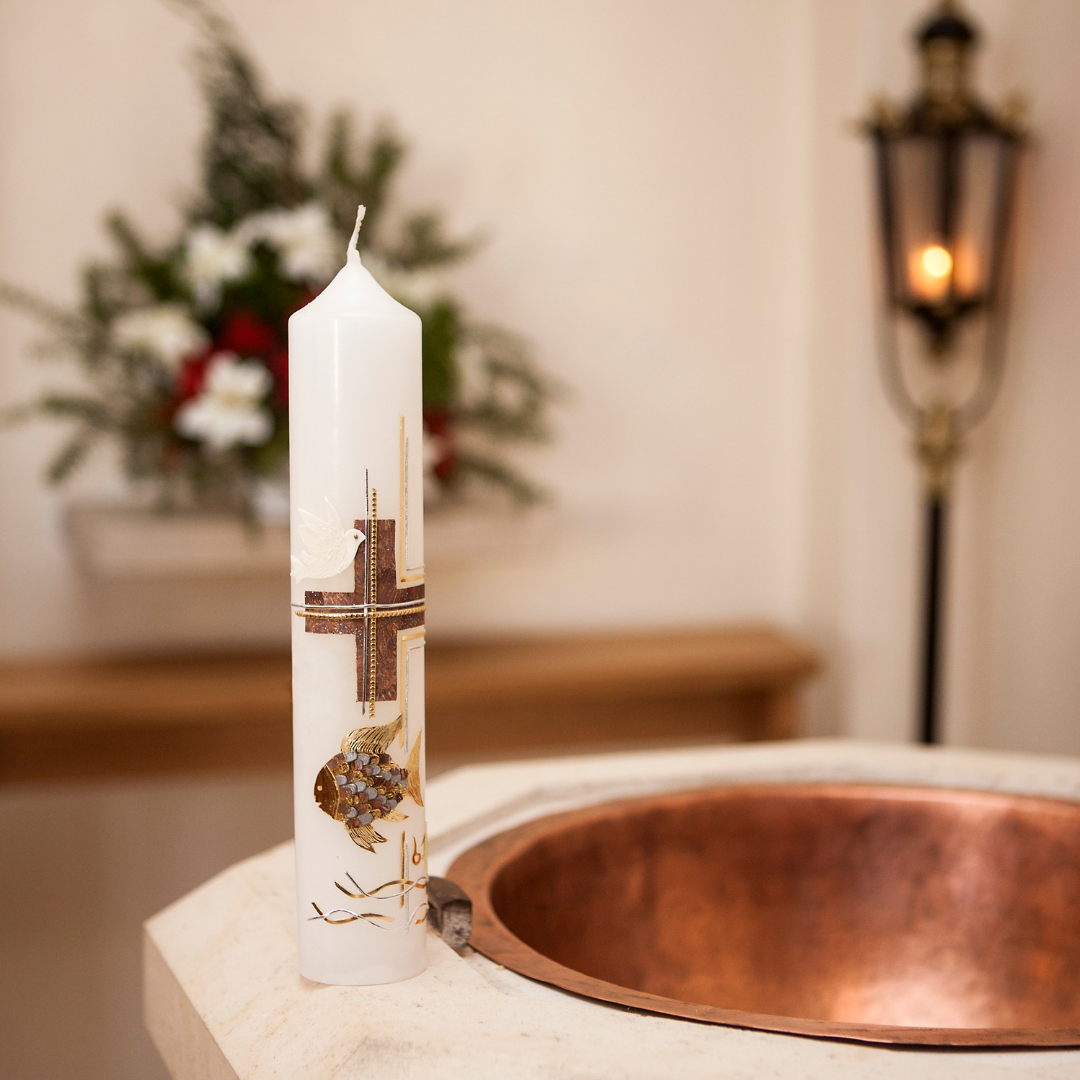
Baptismal font and paschal candle

 Our baby has been born—physically and spiritually! Now begins the lifelong work of nourishing and growing that flame of faith. Part of that involves remembering the momentous event that is one’s Baptism. Every night, my husband blesses each member of the family with holy water—a daily remembrance of our Baptism. We have all of our family’s Baptism days recorded on our calendar so we can celebrate each anniversary. Usually this involves a special dessert after dinner, but always it means renewing one’s baptismal vows (Visit CatholicCulture.org for the prayer). 

The last words of Christ before His Ascension into heaven are an invocation to baptize:

“Go therefore and make disciples of all nations, baptizing them in the name of the Father and of the Son and of the Holy Spirit, teaching them to observe all that I have commanded you.” (Matthew 28:19-20a)

How am I leading others to the waters of Baptism? How often do I thank God for the gift of my own Baptism and that of my family members? Do I pray for the priest who baptized me? 

The most beautiful exhortation that we can address to each other is to always remember our Baptism. … If we are true to our Baptism, we will spread the light of hope—Baptism is the beginning of hope, that hope—of God, and we will be able to pass on to future generations the meaning of life. (Pope Francis, August 2, 2017 General Audience)


Sunday, January 2, 2022

Daily Gospel Reflection for January 2, 2022: The Epiphany of the Lord

 Today's Gospel: Matthew 2:1-12

Where do you find God?

Like the Magi in today’s Gospel, God doesn’t always manifest Himself to us in the ways we assume that He will. Sometimes we find Him in an unexpected place and in an unassuming manner.

The Magi knew that they sought a newborn King. Knowing the infant to be royalty, they assumed He would reside in a majestic palace. Therefore, when the Magi reached Jerusalem, they went directly to the current king, Herod, thinking that he would know where to find this heir to the throne. But they were wrong.

Instead, the Magi had to journey elsewhere … not to a castle, but to a manger; not to the mighty city of Jerusalem, but to the humble town of Bethlehem. The Magi did not expect to find a King in such a place and in such poor conditions. Yet, they put aside their expectations, opening their hearts to this mysterious way God wished to come to them.

They trusted in the manifestation—epiphany—of God in this way. And they responded by giving the newborn King their very best treasures, which symbolize the destiny of this incredible child: gold for his perfect Kingship; frankincense for his royal Priesthood; myrrh to anoint His sacred body, given up to death for each of us.

Maybe you sometimes feel, like the Magi, that you can’t find God in your life. You are seeking Him, but there is emptiness and darkness instead. Where is He? Ask our Blessed Mother to help you. Like the Magi, you will surely always find “the child with Mary his mother” (Matthew 2:11).


Ponder:


Are you seeking the newborn King in all the circumstances, places, and people of your day, and—like the Magi—are you ready to respond by giving Him your very best?


Pray:


Lord, help me never to stop seeking You, knowing that You are the answer to all my deepest hopes and desires. Blessed Mother, please draw me close to your Son. Amen.


Monday, December 13, 2021

A Winning Approach to Defending the Catholic Faith

 “Roman Catholicism concerns me.” 

My acquaintance, a Protestant, proceeded to hand me a paper, peppered with Scriptural citations, explaining the major theological errors with Catholicism. I hardly knew how to respond. I desperately needed a toolbox: a go-to guide to help me formulate a Catholic defense to these arguments. 

Blue Collar Apologetics is that toolbox and its author, John Martignoni, is that adept guide. Martignoni has spent the past twelve years working in Catholic apologetics: he has led a weekly Catholic apologetics program on an Evangelical radio station, distributed more than one million audio copies of talks he has given, and hosted an apologetics show on EWTN.


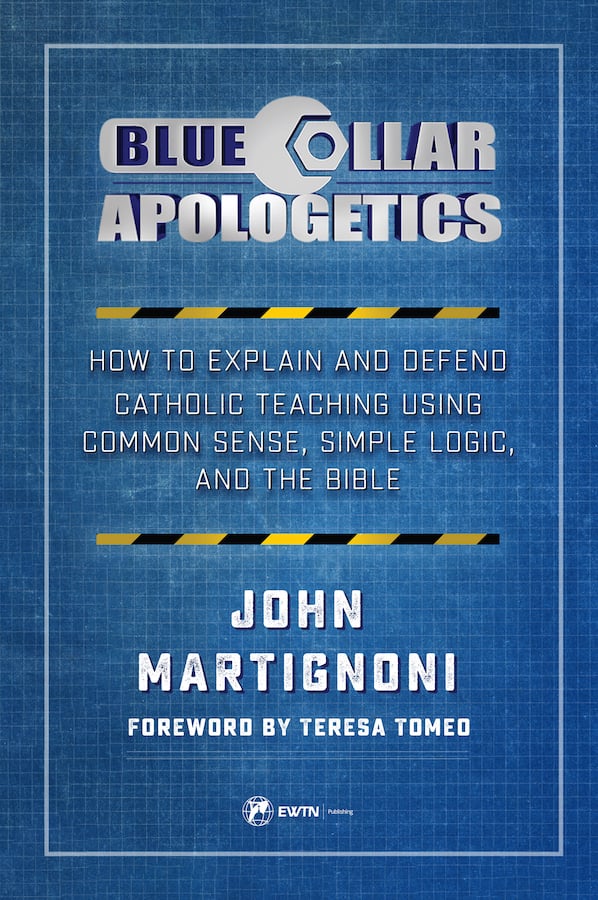
Blue Collar Apologetics


We All Need Apologetics

You might object, “I don’t engage in theological debates with Protestants, so this book doesn’t apply to me.”

Martignoni makes it clear that he intends this book first and foremost for evangelizing Catholics. He writes, “You cannot explain what you do not know. You cannot defend what you cannot explain.” So Blue Collar Apologetics is first about helping Catholics know and understand their faith. No matter what your level of education or formation, we could all deepen our catechesis.

“Apologetics is too complicated and involved for me,” you may think.

If that’s your concern, then this book is perfect for you! Martignoni’s audience is the average Catholic. He writes in a very down-to-earth, approachable manner, so I never felt lost or intimidated while reading.


The Four Strategies

Martignoni uses common sense, logic, and the Bible in shaping his defense of Catholic teaching. He also employs four “strategies": go-to tactics you can employ individually or collectively when dialoguing with Protestants.

Martignoni calls the first strategy “The Ignorant Catholic.” If someone asks you a question about Catholicism and you don’t know the answer, it’s okay to say, “I don’t know.” But make sure to add, “I will find out the answer and get back to you” (and follow through!).

The second strategy is “How to be Offensive (Aw-fensive) without Being Offensive (Uh-fensive).” Stop being on the defensive; start asking your own questions to encourage the other person to consider his or her beliefs. If a Protestant says that we are saved by faith alone (Sola Fide), counter with this query: So do we need to love God in order to be saved? If the answer is yes, then we are not saved by faith “alone.”

Strategy number three—”It’s the Principle of the Thing”—pulls Catholic principles out of Scripture. For example, a Protestant may ask where one can find Purgatory in the Bible. While the word “Purgatory” itself doesn’t appear in Scripture, the truth behind that teaching does. You can point to a verse such as Revelation 21:27: “But nothing unclean shall enter it [heaven].” The principle underlying this verse is that no stain of sin will enter heaven.

Finally, the fourth strategy is called “But That’s MY Interpretation.” This centers on the question of authority. Protestant theology typically implies that each person has the right to read and interpret the Bible for him or herself. So, according to their own teaching, your interpretation has the same authority as theirs. Since they are fallible, that means anything they say to you could be the wrong interpretation.


Major Debates

Using these four strategies, Martignoni tackles the major topics of debate between Catholics and Protestants:

  • Authority
  • Sola Scriptura
  • Sola Fide
  • The Sacraments (Baptism, Confession, the Eucharist, and Marriage)
  • Mary
  • The Pope
  • Purgatory
  • Once Saved, Always Saved
  • The Rapture

Martignoni includes a third section addressing Eastern Orthodoxy and atheism as well.


Eye-Opening and Inspiring

This book led me to treasure and understand my faith in a more profound way. I specifically would like to highlight Martignoni’s discussion on marriage, which I found beautiful.

Beginning in Genesis, God reveals His three-step plan for marriage. First, man leaves his father and mother (making a total commitment), then man cleaves to his wife (giving himself totally and completely), and last, the two become one flesh. Matrimony is a process, which begins with the wedding ceremony, but is not completed until the husband and wife come together in the marital embrace. The marital embrace is a renewal of their wedding vows: a re-presentation of themselves to one another and to God.

Jesus also went through this same three step process for His Bride, the Church. First Jesus left His heavenly Father and His earthly mother (Mary) to establish His own family, the Church. Jesus cleaves to His Bride, the Church, giving Himself fully without reservation. Through His death, Jesus makes us one with Himself. The Bridegroom is presented to the Bride (the Church) at the Wedding Feast: the Eucharist, a re-presentation of His self-gift on the Cross.

Martignoni asserts that the Eucharist “is the ultimate marital embrace.” In this sacrament, Jesus plants the seeds of eternal life in our bodies. From this parallel, he proceeds to demonstrate why the Catholic Church teaches against contraception, something most Protestants do not understand. The root of the problem is that, lacking a Eucharistic theology, Protestants cannot have a correct theology of Marriage. 

Get a Copy!

I have taken extensive notes from my reading of Blue Collar Apologetics. I highly encourage you to pick up this book! You never know when God will put you in a position to evangelize someone. Be prepared and confident for these opportunities, and in the midst of reading Blue Collar Apologetics, deepen your own love of the Catholic Faith.


Tuesday, November 2, 2021

God's Hospital for Souls

Our children like to play a game where they dump as many toys as possible onto the floor. I knew they were in the midst of this game one day when I overheard our son say, “Mom’s not going to like this.” 

Indeed I didn’t. I entered the bedroom to find the floor scattered with dinosaurs, duplos blocks, and game pieces. 

I was — justifiably — angry. The children know that intentionally making a mess is wrong. They promptly apologized and I forgave them, of course. 

But that wasn’t the end of the story because the mess remained.


A Mess in Our Souls 

Something similar happens in our souls. 

When we go to the sacrament of Confession, God always forgives us our sins, removing eternal punishment and restoring our relationship with Him. But, like the mess in the bedroom, sin leaves a kind of mess in our souls. 

We may have a lingering tendency to commit the same transgression. Sins leave the soul lacking in love. Also, there is a need for correction. I forgave our children for the mess they made, but they had a punishment: clean it up! Similarly, as God’s children, we receive temporal punishment for our sins. We also need to be corrected through punishment when we willingly and knowingly disobey our Father. 

We all need purification. The question is: when will we be purified? Sometimes it happens in this life; other times, it’s in the next.


woman praying


All Saints and All Souls 

On November 1 we celebrate All Saints Day, thanking God for our friends in heaven (the Church Triumphant). The saints are our heroes: they’ve won the race and now cheer us on. They have been purified: there is no mess in their souls! 

If you look at the lives of the saints, you’ll find a common theme running through their varied stories: suffering. They united their suffering with the suffering of Christ on the cross. They allowed that suffering to purify them. That suffering made them saints! 

They chose to be purified now, here, on earth. Through suffering they became detached from all sin and made reparation for any damage caused by their previous sins. Thus their love for God was so pure that, at the moment of their death, they entered directly into heaven. 

Then we come to November 2: All Souls Day. This is the day when we especially pray for the souls who were not fully purified here on earth: the souls in Purgatory. The Catechism of the Catholic Church explains that Purgatory is a “purification, so as to achieve the holiness necessary to enter the joy of heaven.” As the book of Revelation says of heaven, “nothing unclean will enter it” (21:27).


God’s Hospital for Souls 

Purgatory is God's hospital for souls. A patient in a hospital realizes that he or she is sick and needs a cure. He or she recognizes that a cure will come only through suffering — surgery or a medical procedure. The infirm person willingly proceeds with the suffering, knowing that it is for his or her ultimate good and in hope for full health one day. 

Similarly, the souls in Purgatory (the Church Suffering) await the ultimate cure: the bliss that is the Beatific Vision. Father Benedict Groeschel writes in his book After This Life, referring to sinfulness, that Purgatory “heals it, cleansing the human soul, gently and lovingly making us into the beings God wants us to be.” 

Joyfully, Purgatory has just one exit door and that is to heaven. But until the purification is complete, the soul will experience a suffering "more painful than anything a man can suffer in this life" (St. Augustine). The souls in Purgatory suffer because they see so clearly the evil of their sins and sin's effects. 

While being purified, these holy souls in Purgatory cannot earn merit for good works: they cannot hasten their entrance into heaven.


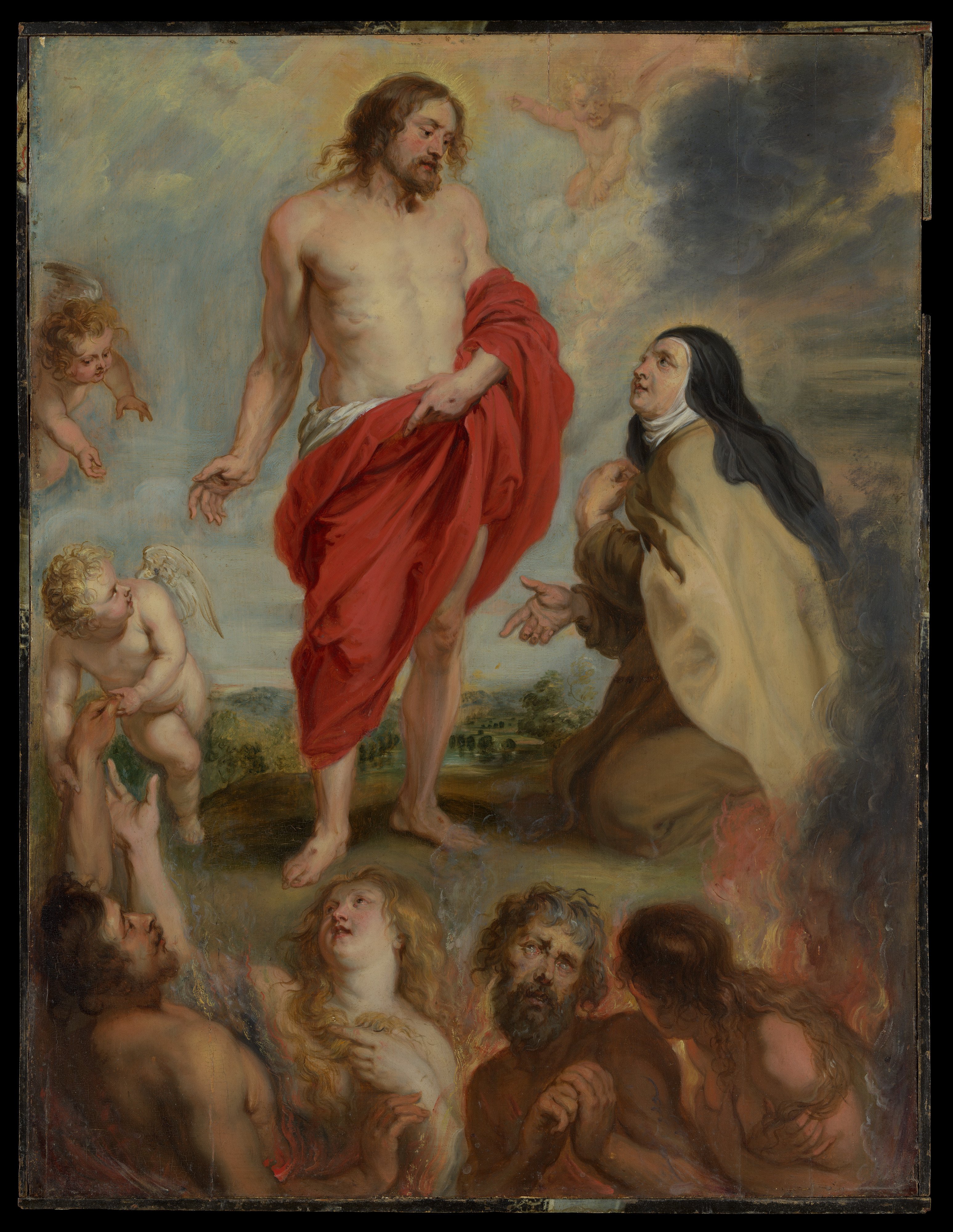
St Teresa of Avila interceding for souls in purgatory


We Need to Help

We all have loved ones who have died. Don't assume that they are definitely in heaven already, because if they are in Purgatory, they need your prayers! Offering God your suffering, prayers, work, and difficulties for the souls in Purgatory is a way to show these departed ones your love.

My own family has gotten into the habit of praying for the souls in Purgatory immediately after we say our grace before each meal. We pray: “And may the souls of the faithfully departed, through the mercy of God, rest in peace.”

Consider having a Mass offered for someone who has died. Mass is the highest form of prayer and worship here on earth, so there are many graces that flow from this practice. As the Catechism of the Catholic Church states, “From the beginning, the Church has honored the memory of the dead and offered prayers in suffrage for them, above all the Eucharistic sacrifice, so that, thus purified, they may attain the beatific vision of God.”

We can (and should) remember the souls in Purgatory every day, but most especially now, in the days following All Soul's Day.

Each day from November 1 until November 9 we can gain a plenary indulgence for a soul in Purgatory. An indulgence is the remission of temporal punishment due to sin. The Church has an infinite treasury of merit (good works) “stored” up, so to speak. These merits are from Christ’s Passion and death, as well as the good works of our Blessed Mother and the saints.

So an indulgence is the exchange of spiritual goods from the treasury of the Church to a particular soul — in this case, the indulgence could be applied to a soul in Purgatory. A plenary indulgence is extremely powerful: it removes all temporal punishment due to sin, allowing a soul in Purgatory to go to heaven!

In order to obtain this plenary indulgence, one must:

  1. Visit a cemetery (any cemetery will do; it need not be the one where your loved one is buried).
  2. Say a prayer for the particular soul for whom you wish to gain the indulgence.
  3. Attend Mass the same day (and receive Holy Communion).
  4. Go to confession within 20 days of the cemetery visit.
  5. Have a spirit of detachment from all sin.
  6. Pray an Our Father, Hail Mary, and Glory Be for the intentions of the Pope.

These souls in Purgatory will be so grateful for your prayers! As Venerable Fulton Sheen said,

As we enter Heaven, we will see so many of them, coming towards us and thanking us. We will ask who they are and they will say: "A poor soul you prayed for in Purgatory!”

 Eternal rest grant unto them, O Lord,

and let perpetual light shine upon them.

May the souls of the faithful departed,

through the mercy of God, rest in peace. Amen.


Saturday, October 2, 2021

My Guardian Dear

 A messenger

I sat in the quiet Adoration chapel very early one morning during my college days. Just myself and an elderly woman were there, as per usual, and my heart felt particularly heavy that day with a pressing problem. Suddenly the chapel door opened and a young man, around my age, entered. He knelt a few pews behind me and I wondered who he might be — I had never seen him there before. A few minutes later, to my great surprise, he walked up to me.

“This is from your Mother,” he said, placing a Miraculous Medal in my hand. “She is praying for you.”

He abruptly left and I never saw him again.

Did you know that the word angel means "messenger?"


Angels really exist

Do angels really exist? Aren’t angels fantasy or myth, the topic of Lifetime movies or children’s stories?

The Bible is very clear about the reality of angels. At the major moments of salvation history, angels were present. An angel guarded the gate to the Garden of Eden after the Fall of Man. Angels appeared to Abraham to share the news that he and his wife would bear a child. Later, an angel stayed the hand of Abraham when he prepared to sacrifice his son. The archangel Gabriel announced to the Virgin Mary that she would become the Mother of the Savior. Then, at the Savior’s birth, angels danced and sang for joy in the midnight sky. Angels ministered to Jesus after Satan tempted Him in the desert. They likewise comforted Him during His agony in the garden. The morning of the Resurrection, an angel announced that Jesus was alive. When He ascended into heaven, an angel encouraged the apostles to return to Jerusalem and their ministry. An angel aided St. Peter in escaping from prison. When Christ comes again, the angels will trumpet His glorious return.

Church Tradition has similarly been clear about the existence of angels. The Catechism of the Catholic Church states, “The existence of the spiritual, non-corporeal beings that Sacred Scripture usually calls ‘angels’ is a truth of faith. The witness of Scripture is as clear as the unanimity of Tradition.”

But, if we need further evidence, just consider for a moment the order and hierarchy of the natural world. Think about all of the creatures that exist, starting with a single-cell organism, all the way up to the complex human person. There are so many creatures along the steps of that hierarchy. Analogously, why wouldn’t God do the same in the supernatural world? At the bottom is man (body and spirit); at the top is God (perfect Spirit). What fills in the space between those two? Angels.


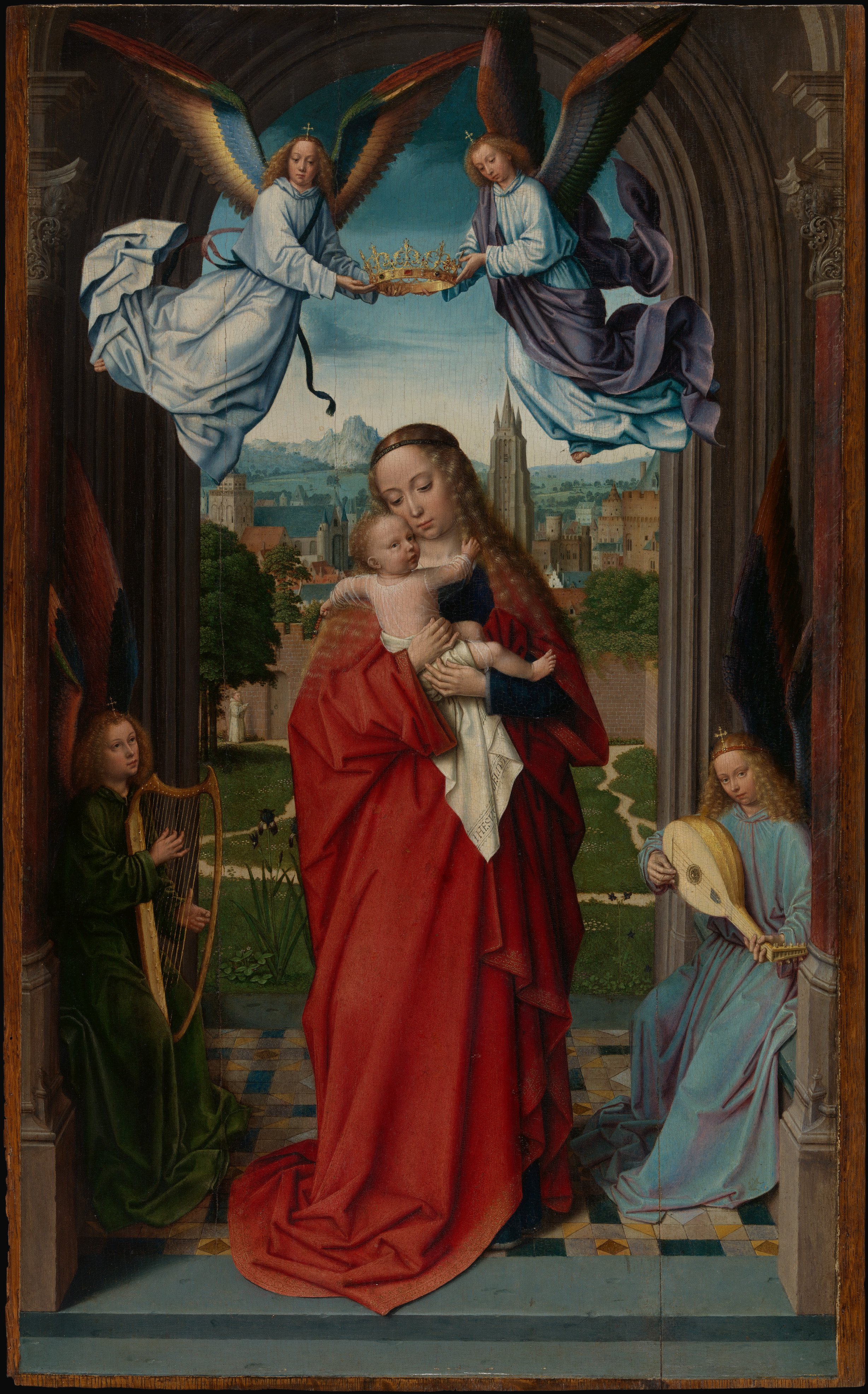
Gerard David, MetMuseum.org, "Virgin and Child with Four Angels" Public Domain


What, exactly, is an angel?

Angels are all around us, even though we may not be aware of them. Most times, we cannot see them. Unlike humans, angels are pure spirit: they have no body, no physical matter. Because they have no body, angels are neither male nor female. They also can never die, since they have no body that can be destroyed. The Catechism of the Catholic Church states, “As purely spiritual creatures angels have intelligence and will: they are personal and immortal creatures, surpassing in perfection all visible creatures, as the splendor of their glory bears witness.”

Sometimes people think that we humans become angels after we die. However, an angel is an entirely different species from people. Humans can’t become angels, though it would help us to try to act like them!

We often think of angels as chubby little cherubim, sweet and innocuous. But in reality, angels are supremely powerful, fearful (in a good way) and “awe”-some. Consider this: just about every time an angel appears in Scripture to someone, the angel immediately reassures, “Do not be afraid!”


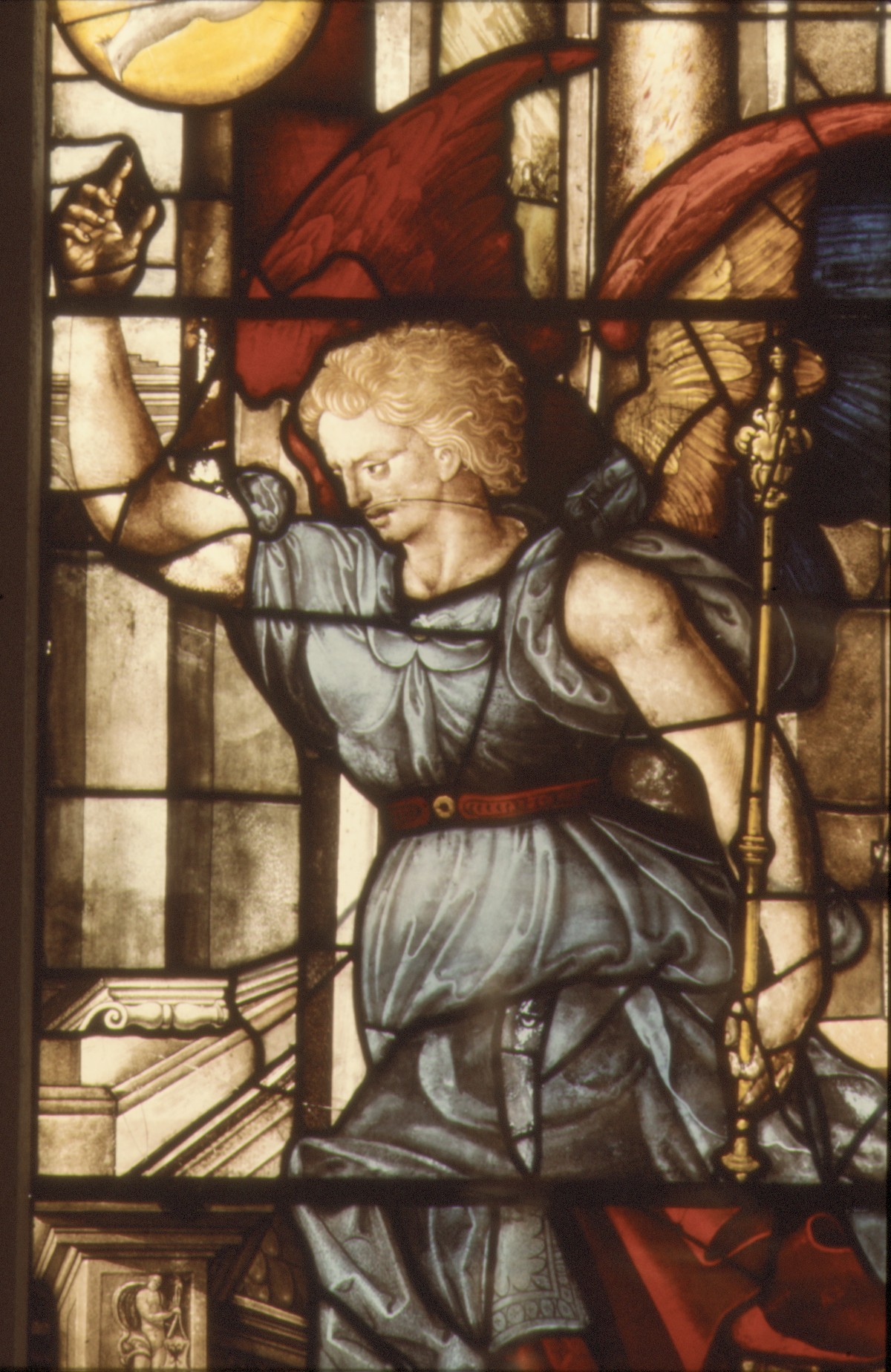
stained glass window depicting archangel Gabriel, 1552, MetMuseum.org, Public Domain


Angels are pure intellect: they know perfectly and immediately. (This is why, in art, angels are sometimes depicted as heads with wings on either side!) Our knowledge is gradually acquired, but an angel knows instantly. As Peter Kreeft in his book Angels (and Demons) writes, “They are more brilliant minds than Einstein.”

As I mentioned, the word angel means “messenger.” It describes more what angels do, than what they are. As messengers, they have various roles. Actually, there are nine different levels (or choirs) of angels, from the seraphim at the top to the guardian angels at the bottom. 


20211002 CSpellman 2


Angels are God’s gift to us

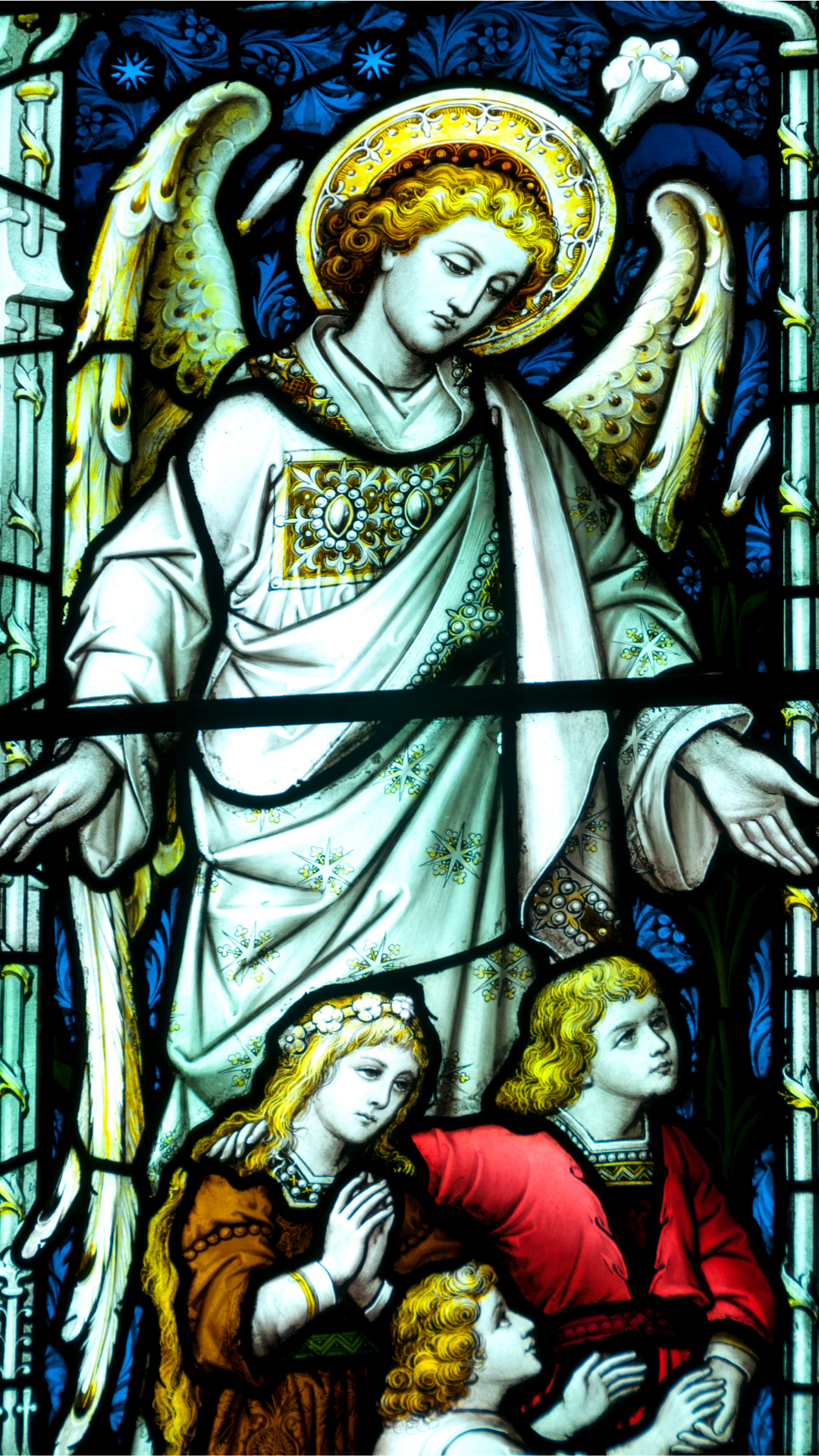
Your guardian angel is an incredible gift from God! Just think: from the moment of your conception, there is an angel by your side at all times. That angel’s whole purpose is you! God has created an angel for the sole purpose of protecting, guarding, and watching over you!

Sometimes angels intervene in our lives in a miraculous way. When angels appear this way, it’s as though they are putting on a very realistic costume. We see this in Scripture in the Book of Tobit, when the Archangel Raphael appears as a man to help Tobias and his family.

More often though, angels help us behind the scenes in quieter — though no less potent — ways. Your guardian angel may give you strength in a moment of temptation. Or maybe sometimes you’ve had a sudden inspiration or idea. Its source could be your guardian angel! Also, your guardian angel prays for you before the throne of God in heaven.

The Church has two special days devoted to angels. September 29 is the Feast of the Archangels (Michael, Raphael, and Gabriel) and October 2 is the Feast of the Guardian Angels. These are good days to thank God for the gift of the angels! And remember, “Do not neglect hospitality, for through it some have unknowingly entertained angels” (Hebrews 13:2). 

Angel of God, my guardian dear,
to whom God's love commits me here,
ever this day, be at my side,
to light and guard, rule and guide.
Amen.