Showing posts with label Suffering. Show all posts

Saturday, June 24, 2023

Lessons from The Fool of New York City

You wake up in a room you don’t recognize. You shiver inside a coat you’ve never seen before. You touch your face, which you know is yours but you can’t identify it. You look out the window at a city, and you have no idea how you got here. 


You have taken a wrong turn somewhere; you have fallen asleep and lost yourself. And now you are awake again but have not refound yourself.


So begins The Fool of New York City by Michael O’Brien. The helpless protagonist is completely lost: he has no memory of his past, and the little glimpses he has into his locked-away memories could be unreliable. For example, he believes his name to be Francisco De Goya, the Spanish artist. 


Thankfully, Francisco does not have to survive on his own for long. A giant named Billy Revere comes to his aid. At first Francisco shrinks from the giant’s overwhelming presence, suspecting that this stranger may wish him ill-will. Billy’s acts of generosity, kindness, and thoughtfulness soon convince Francisco otherwise.


For here is immense strength, and it is mastered. Here is perfect form and balance, yet it is without vanity. This man does no harm.


As someone who once suffered from amnesia himself, Billy has special empathy for Francisco and goes to great lengths to help him remember, following little clues that may hold deeper meaning. 


There are layers in existence.


O’Brien does an incredible job of slowly unraveling the mystery of Francisco’s life, unfolding what led him to this state and revealing that he and Billy have more in common than they first believed. The author uses a powerful metaphor of the pond: relics of the past, hidden at the murky bottom underneath the water, that Francisco tries to see. Autumn leaves of years ago hide the truth of what has happened to him. Francisco tries to cross the frozen pond and cracks appear, the truth leaking through … and possibly drowning him in its pain. Can Francisco dredge through the pain of his past to find clear waters?


I found it fascinating that O’Brien opened his novel in the second person point of view, something I’ve only read in a “choose-your-own-adventure” book. But it was a brilliant tactic because he places the reader in the shoes of this protagonist who is so lost. Haven’t we all felt that sometimes, to some degree? Have you ever gazed at yourself in the mirror and wondered who you’ve become? 


A losing can be a better kind of finding.


Much of this book deals with the idea of identity. Who are we, at our essence? Sometimes it takes a moment of crisis to strip away pretenses and reveal the truth at the core of our person. 


And when we think that we know someone, we can be wrong. Appearances can be deceiving. Many characters in the book came across Billy, an anomaly for his enormity, and shunned him or failed to see him as a person: as someone more than his incredible height of 7 feet, 11.5 inches. Who is the fool then?


Also: what defines us? Both Billy and Francisco experienced great pain in their pasts. Billy hurries into a crisis situation, like his namesake Paul Revere, warning of danger and trying to help—even placing himself in harm’s way. He took his pain and let it define him in a positive way: he became a rescuer because he knew what it felt like to be lost. That’s his identity.


Billy was who he was not only because of his nature and upbringing but also by his personal sufferings—rather, by what he had done with them.


Francisco’s challenge is to take his pain and not let it chain him anymore. 


… when a person faces himself—truly faces himself for what he is—he can make a new start, deal with the weaknesses and work on strengthening the better parts.


You are not the creation of the things that happen to you.


Do I let my past hurts define me in a negative way that prevents me from being fully free? This book is one of transformations: from lost to found, from hurt to healed, from past to present.


You can bury the memory and think it’s dealt with, done and gone. It is never gone, but it must be transformed into something that gives us life. To overcome death, you must create life.


I hope that you have the courage to dive into the deep waters of your history and then break free to the surface of the water, renewed and strengthened in the essence of who you truly are: you are more than the bad things that happen to you. 


Saturday, March 11, 2023

Blessed with the Cross


“Twelve years ago I was blessed with cancer.”

I heard this powerful statement from a speaker during an online conference I recently attended. I am still struck by her choice of words. Blessed with cancer? It seems almost like an oxymoron.

Yet, during this season of Lent, I feel particularly close to Christ’s cross. Our nine-year-old son has been sick for six weeks. As any mother knows, it’s so painful to watch your child suffer. But how can I suffer well? How can I help my children to suffer well?

Meaning in Suffering

This time has challenged me to embrace, not run, from suffering. What if I can find peace, joy, contentment, and meaning—not only on days that go well, plans fulfilled, restful nights, and relaxation—but also on days where all my plans unravel, nights repeatedly interrupted by a sick child, new and unexpected responsibilities, and no free time?

I remember a story someone once shared with me. Christ appeared before a man and offered him a cross. The man looked at it and said, “Oh no! I could never carry that! It’s much too heavy for me. Send me another cross.” So Christ brought the man into a large room, filled with other crosses, all of which were much larger and heavier. “What cross would you like now?” Christ asked. The man glanced back at the original cross … suddenly it seemed so much lighter. 

Christ will never give me a cross that I cannot carry. I looked at my son, coughing for probably the millionth time, and reassured him, “Christ will never give you a cross that you cannot carry.” His slender shoulders can bear the weight of this illness. Who am I to say this cross is too heavy for us?

The pathway of pain, properly tread, offers us so much. It is not a punishment from God, but an invitation to unite our suffering with the suffering of Christ on the cross. Christ calls us to pick up our cross every day. A day without the cross is a day without Christ. I explained to my son that we can take this suffering and transform it into something beautiful. We can accept that this is what God wants of us right now and, if it’s God’s Will, it’s what is best for us. 

Simon of Cyrene can inspire us. Perhaps, as the Roman soldiers summoned him forward, Simon thought: Why me? Maybe Simon wanted to run from the cross too. There were so many people lining the street watching Jesus carry His cross. Yet Simon was the one chosen for the job. Maybe that’s how Simon viewed the task at first: a job, an unpleasant suffering. Yet as he carried that cross alongside Jesus, how must have Simon been transformed? He must have walked away a different man, forever changed by that shared suffering. It wasn’t a punishment; it was a gift.

We hear stories of the saints who bear the wounds of Christ: the stigmata. On first impression, it seems like such a magnificent miracle! And it is. But sometimes, in the remarkableness of it, it’s easy to overlook that it’s a miracle of suffering: physical pain. Jesus blesses those He loves with the cross.

During Lent, our family has a sacrifice jar on our dining room table. Whenever someone has to do something unpleasant or difficult, he or she puts a dry bean into the jar and offers it up as a sacrifice, turning that cross into a prayer. I watched my sick son come downstairs in the morning. I hear the clink of the dry beans as he puts his sacrifices in—sacrifices for coughing throughout the night, for feeling exhausted, for not being able to go into school … He says nothing, but he offers them to God. 

Suffering, well borne, becomes a training ground for the soul. 

Suffering Reveals Who We Are

The cross also reveals. It strips us open and makes us see ourselves better. What kind of wife, mother, and disciple am I when it gets really hard? Am I just a fair-weather friend to our Lord or am I willing to trust in Him even when things become painful? This cross has humbled me in helping me see the virtues that I lack.

As I prayed during this time, I pictured Christ crucified. I embraced Jesus, clinging to His shoulders and wrapping my legs around his waist, like how a young girl would hug her father. I imagined the sticky sweat on His body, the caked and fresh blood, His gasps for air, the pounding of His heart beneath my ear as I rested my head on His crucified body. I was with Him there on the cross. 

But I also felt the soaring energy and power of God Himself emanating from that throne of glory. 

On a recent Sunday I parked the van in our parish church’s parking lot. My son and I planned to pray from our vehicle, watching the liturgy live streamed from my cell phone, his cough still too bad to have him sit with the rest of the family in the pew. I saw other families entering the church, mothers with their sons, laughing and running up the steps of church. I saw my son next to me, circles under his eyes, coughing harshly. 

This is hard and difficult to bear. I felt tempted to complain. Yet, I sensed Christ telling me: you are so blessed. We have a gift. Jesus loves this son of mine even more than I do and He is inviting us to share in His suffering. Christ is so close to us in the cross. He makes our burden light.

How have you been blessed with the cross today?

Tuesday, November 2, 2021

God's Hospital for Souls

Our children like to play a game where they dump as many toys as possible onto the floor. I knew they were in the midst of this game one day when I overheard our son say, “Mom’s not going to like this.” 

Indeed I didn’t. I entered the bedroom to find the floor scattered with dinosaurs, duplos blocks, and game pieces. 

I was — justifiably — angry. The children know that intentionally making a mess is wrong. They promptly apologized and I forgave them, of course. 

But that wasn’t the end of the story because the mess remained.


A Mess in Our Souls 

Something similar happens in our souls. 

When we go to the sacrament of Confession, God always forgives us our sins, removing eternal punishment and restoring our relationship with Him. But, like the mess in the bedroom, sin leaves a kind of mess in our souls. 

We may have a lingering tendency to commit the same transgression. Sins leave the soul lacking in love. Also, there is a need for correction. I forgave our children for the mess they made, but they had a punishment: clean it up! Similarly, as God’s children, we receive temporal punishment for our sins. We also need to be corrected through punishment when we willingly and knowingly disobey our Father. 

We all need purification. The question is: when will we be purified? Sometimes it happens in this life; other times, it’s in the next.


woman praying


All Saints and All Souls 

On November 1 we celebrate All Saints Day, thanking God for our friends in heaven (the Church Triumphant). The saints are our heroes: they’ve won the race and now cheer us on. They have been purified: there is no mess in their souls! 

If you look at the lives of the saints, you’ll find a common theme running through their varied stories: suffering. They united their suffering with the suffering of Christ on the cross. They allowed that suffering to purify them. That suffering made them saints! 

They chose to be purified now, here, on earth. Through suffering they became detached from all sin and made reparation for any damage caused by their previous sins. Thus their love for God was so pure that, at the moment of their death, they entered directly into heaven. 

Then we come to November 2: All Souls Day. This is the day when we especially pray for the souls who were not fully purified here on earth: the souls in Purgatory. The Catechism of the Catholic Church explains that Purgatory is a “purification, so as to achieve the holiness necessary to enter the joy of heaven.” As the book of Revelation says of heaven, “nothing unclean will enter it” (21:27).


God’s Hospital for Souls 

Purgatory is God's hospital for souls. A patient in a hospital realizes that he or she is sick and needs a cure. He or she recognizes that a cure will come only through suffering — surgery or a medical procedure. The infirm person willingly proceeds with the suffering, knowing that it is for his or her ultimate good and in hope for full health one day. 

Similarly, the souls in Purgatory (the Church Suffering) await the ultimate cure: the bliss that is the Beatific Vision. Father Benedict Groeschel writes in his book After This Life, referring to sinfulness, that Purgatory “heals it, cleansing the human soul, gently and lovingly making us into the beings God wants us to be.” 

Joyfully, Purgatory has just one exit door and that is to heaven. But until the purification is complete, the soul will experience a suffering "more painful than anything a man can suffer in this life" (St. Augustine). The souls in Purgatory suffer because they see so clearly the evil of their sins and sin's effects. 

While being purified, these holy souls in Purgatory cannot earn merit for good works: they cannot hasten their entrance into heaven.


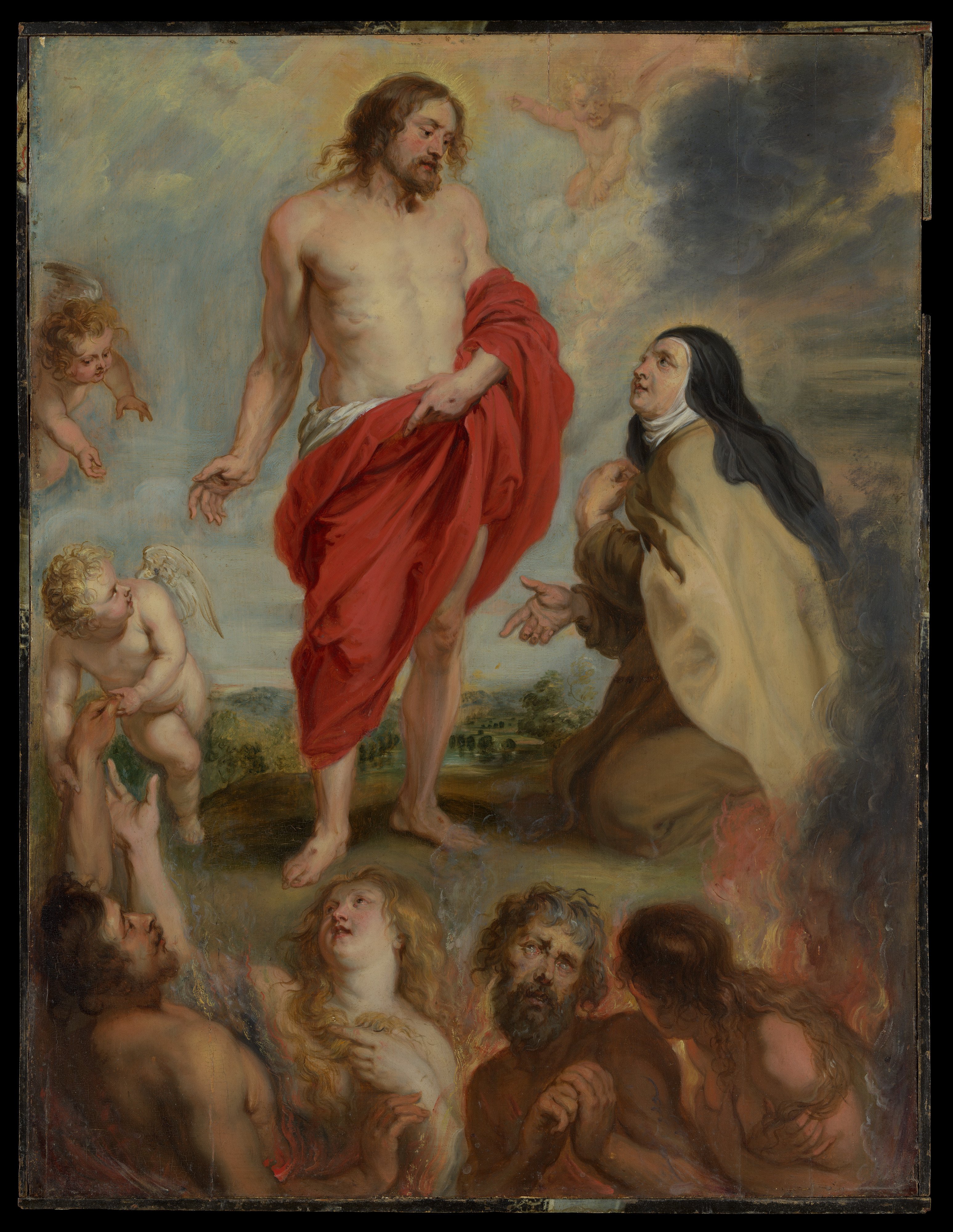
St Teresa of Avila interceding for souls in purgatory


We Need to Help

We all have loved ones who have died. Don't assume that they are definitely in heaven already, because if they are in Purgatory, they need your prayers! Offering God your suffering, prayers, work, and difficulties for the souls in Purgatory is a way to show these departed ones your love.

My own family has gotten into the habit of praying for the souls in Purgatory immediately after we say our grace before each meal. We pray: “And may the souls of the faithfully departed, through the mercy of God, rest in peace.”

Consider having a Mass offered for someone who has died. Mass is the highest form of prayer and worship here on earth, so there are many graces that flow from this practice. As the Catechism of the Catholic Church states, “From the beginning, the Church has honored the memory of the dead and offered prayers in suffrage for them, above all the Eucharistic sacrifice, so that, thus purified, they may attain the beatific vision of God.”

We can (and should) remember the souls in Purgatory every day, but most especially now, in the days following All Soul's Day.

Each day from November 1 until November 9 we can gain a plenary indulgence for a soul in Purgatory. An indulgence is the remission of temporal punishment due to sin. The Church has an infinite treasury of merit (good works) “stored” up, so to speak. These merits are from Christ’s Passion and death, as well as the good works of our Blessed Mother and the saints.

So an indulgence is the exchange of spiritual goods from the treasury of the Church to a particular soul — in this case, the indulgence could be applied to a soul in Purgatory. A plenary indulgence is extremely powerful: it removes all temporal punishment due to sin, allowing a soul in Purgatory to go to heaven!

In order to obtain this plenary indulgence, one must:

  1. Visit a cemetery (any cemetery will do; it need not be the one where your loved one is buried).
  2. Say a prayer for the particular soul for whom you wish to gain the indulgence.
  3. Attend Mass the same day (and receive Holy Communion).
  4. Go to confession within 20 days of the cemetery visit.
  5. Have a spirit of detachment from all sin.
  6. Pray an Our Father, Hail Mary, and Glory Be for the intentions of the Pope.

These souls in Purgatory will be so grateful for your prayers! As Venerable Fulton Sheen said,

As we enter Heaven, we will see so many of them, coming towards us and thanking us. We will ask who they are and they will say: "A poor soul you prayed for in Purgatory!”

 Eternal rest grant unto them, O Lord,

and let perpetual light shine upon them.

May the souls of the faithful departed,

through the mercy of God, rest in peace. Amen.


Friday, September 10, 2021

Lessons from Left to Tell

 “I have killed 399 cockroaches,” said one of the killers.  “Immaculée will make 400.  It’s a good number to kill.”

In high school I read a historical fiction novel by Michael Shaara about the battle of Gettysburg.  I don’t recall the lines verbatim, but there is an exchange between two characters that has always stayed with me.  One soldier quotes a line from Shakespeare's Hamlet: "What a piece of work is man ... in action how like an angel!" His companion, in a dry tone, responds that if man is an angel, then he is a murdering angel.  (Hence the title of the book, The Killer Angels.)


It does seem that at times man is capable of tremendous acts of sacrifice, virtue, and goodness—even comparable to an angel.  Yet, there are seemingly as many examples of man committing heinous atrocities like brutal violence, rape, and sacrilege—much like a devil.


Both of these extremes of goodness and evil are present in Immaculée Ilibagiza’s biography, Left to Tell, which tells of her experiences during the Rwanda genocide in 1994.  The book is gripping and astonishing.


Sadly, Rwanda’s history—like many African nations—was altered for the worse due to the colonizing interference of outside countries.  Rwanda was composed of three tribes: a Hutu majority, Tutsi minority, and a small number of Twa (forest dwellers).  Originally, Rwanda enjoyed many years of peace under a monarchy, ruled by a Tutsi king.  However, German and then Belgian colonists purposely altered Rwanda’s social structure for their own personal benefit.  


Pinning the tribes against each other, the Beglians promoted the minority Tutsi aristocracy, providing them with a better education so they could run the country well … thereby earning more money for their Belgian rulers.  The Belgians distributed identity cards as a way to distinguish between tribes.  The Hutus grew resentful, an anger that perpetuated through the future generations.


When the Tutsis sought independence from Belgium, the Belgians turned against them, supporting a Hutu revolt in 1959.  The revolt overthrew the monarchy and killed many Tutsis (more than 100,000).  This was just the beginning.  In 1962 Belgium officially left Rwanda, leaving a Hutu government in control, which continued the persecution of Tutsis.


Immaculée and her family belonged to the Tutsi tribe, although, as a child, she was unaware of any such differentiation.  Her parents, faithful Catholics and leaders in their community, welcomed everyone into their home and extended a helping hand to those in need, regardless of tribe.  In reality, very little separated a Hutu from a Tutsi.  Due to intermarriage, their physical features often appeared identical.  They spoke the same language and shared a common history and culture. 


Nevertheless, as Immaculée grew, the discrimination against Tutsis began to affect her life in a more direct manner.  The Rwandan government had an “ethnic balance” plan to ensure that the Hutus received a better education.  So although Immaculée finished second in her eighth grade class, she did not receive a scholarship to high school, due to her being a Tutsi.  Her parents had to make a significant financial sacrifice to afford her continued education.


Things escalated in October 1990 when Rwanda was attacked by a group of Tutsi soldiers (called the Rwandese Patriot Front, or RPF).  These soldiers had been living in neighboring Uganda.  Grown children of previous Tutsi refugees, they sought to return to their home country.  Fighting spread and continued, on and off for years, in the north of the country between these Tutsi rebels and the Rwandan government soldiers.


Meanwhile, in local communities, radical groups sprang up.  The President of Rwanda encouraged the formation of these Interahamwe, meaning “those who attack together.”  The Interahamwe attracted homeless teens, many of whom were drug addicts, and became a Hutu-extremist militia.


While away at university one day, Immaculée received an urgent message from her father, imploring her to return home.  She had originally planned to wait until Easter break, but decided to answer her father’s request and arrived home early, armed with books for continued study.  Immaculée joined her parents and two brothers for what seemed like a regular family dinner at home.  Yet, after the jokes and shared stories, her older brother, Damascene, broke out:


“No, I’m not imagining things,” Damascene said, getting to his feet and speaking with urgency.  “And that’s not all I saw.  They have a list of names of all the Tutsi families in the area, and our names are on it!  It’s a death list!  They are planning to start killing everyone on the list tonight!” 


Immaculée was troubled, but her father reassured them that such news was being exaggerated and people were overreacting.  However, unbeknownst to them at the time, that was their last family dinner together.  The next morning news reports informed the citizens of Rwanda that the President was dead, his plane having been shot out of the sky.  The radio announced:


“Stay in your homes.  It is forbidden to travel.  Only military personnel will be allowed in the streets.  Do not go outside.  Public transportation has been suspended.  Do not leave your homes!”


The date was April 7, 1994 and the genocide had begun.  With it came evil of such magnitude, it’s hard to even comprehend.


Local radio stations immediately encouraged Hutu citizens to grab a machete and kill any Tutsi neighbors, no questions asked.  Government officials even handed out machetes at gas stations and the militia went door-to-door, delivering guns and grenades.  


The country came to a grinding halt: all phone lines down; businesses, stores, and schools closed; public transportation ended … all done so that every person could pour every effort toward the goal of wiping out the Tutsi population. 


The radio further instructed the Tutsis to seek refuge at churches and stadiums.  However, this was just a ruse: these became places of mass killings, as Hutus attacked the sites, burning the people alive inside and shooting anyone who attempted to escape.  


Ntrama Church Altar, where over 5,000 people seeking refuge were killed


Immaculée describes the Interhamwe as they scoured her neighborhood, seeking Tutsis to kill:


Hundreds of people surrounded the house, many of whom were dressed like devils … They whooped and hollered.  They jumped about, waving spears, machetes, and knives in the air.  They chanted a chilling song of genocide … These were my neighbors, people I’d grown up and gone to school with—some had even been to our house for dinner.


The evil directly attacked Immaculée’s family, who were all brutally and savagely murdered.  The genocide continued for three whole months and claimed the lives of almost one million Rwandans.  


And yet, through God’s grace, even in the midst of such profound darkness and pain, Immaculée found a way to find light and goodness.


The day the genocide began, Immaculée’s family, concerned what the Interahamwe would do to her (they were known to rape women before killing them), sent Immaculée to a nearby Hutu pastor’s house.  For ninety-one days she, along with seven other women, hid in the pastor’s bathroom.


The conditions these women endured are astonishing.  The bathroom was four feet long and three feet wide.  Near the ceiling was a small air vent.  The women couldn’t flush the toilet unless the bathroom toilet on the other side of the wall was being used.  There wasn’t enough space for them all to sit on the floor, so the tallest women sat with the shorter ones on top of them.  Every twelve hours they would stretch, but aside from that, they stayed in the same position day and night.  The women remained completely silent, communicating only via sign language.  They became emaciated, surviving only on the scraps the Pastor brought to them.


And yet, in this unlikeliest of places and such trying circumstances, Immaculée experienced a profound deepening in her relationship with God.  He became her refuge.  That tiny bathroom became a sanctuary for her soul.


Even as my body shriveled, my soul was nourished through my deepening relationship with God.


Immaculée centered her entire day around prayer.  After awakening, she would begin prayers of thanksgiving—for the Pastor who took them in, for the life she still had, for her faith.  Then she prayed the rosary, using the beads her father had given to her when saying goodbye.  She spent hours meditating on Bible passages, or sometimes even a single world like “hope.”  


God stayed with her and protected her.  When the Interahamwe searched the Pastor’s house, they originally bypassed his bedroom, thus sparing the women.  The killers vowed to return though and God gave Immaculée a vision of a wardrobe, pulled in front of the bathroom door, thus shielding their hiding place.


While war waged outside of the bathroom, at times it waged inside of Immaculée’s soul as well.  She clung to God because there were moments she was tempted to despair due to direct attacks from the devil within the interior of her soul.


I realized that my battle to survive this war would have to be fought inside of me.  Everything strong and good in me—my faith, hope, and courage—was vulnerable to the dark energy.  If I lost my faith, I knew that I wouldn’t be able to survive.  I could rely only on God to help me fight.


Her greatest struggle was being able to forgive the people committing the genocide—those who had killed her own beloved parents and brothers.  The devil taunted her as she called on God, mocking the hatred she had in her own heart and condemning her for her desire to destroy those who destroyed her family.  Immaculée at first couldn’t comprehend how she could forgive these killers.  She listened as, outside the window, the Interahamwe killed a young mother and left her baby alone, wailing the whole day, until the child’s cries weakened and then stopped, presumably dead.  Who could forgive someone callous and dreadful enough to commit such deeds?  Yet God spoke to her in prayer:


You are all my children … and the baby is with Me now.


Immaculée began to view the killers as children, children hurting others without thinking, hurting themselves in the process.  She began to pity them and to forgive them.


Their minds had been infected with the evil that had spread across the country, but their souls weren’t evil.  Despite their atrocities, they were children of God, and I could forgive a child, although it would not be easy.


Left to Tell is a story of a genocide and it’s a sombering look at the egregious deeds man is capable of committing.  Yet, I don’t think Immaculée would want readers to walk away from her autobiography with only that message in their heart.  It is, ultimately, a story of goodness: God’s goodness that triumphs over evil, that loves and protects.  Even though Immaculée lost her family members in the genocide, God gave her a vision of them, joyful in heaven.  God took care of them, too.  Immaculée cooperated with God’s grace and emerged from an unthinkable experience stronger in her faith with forgiveness in her heart, breaking the cycle of hatred that perpetuates persecutions and genocides.


God is taking care of me and you as well.  Like Immaculée, we need to cling to Him and stay as close as possible through prayer.  God will give us the strength to resist our temptations, forgive those who hurt us, and grow in love if we lean on Him.  He will be our shelter, if we allow Him.


Monday, July 12, 2021

Lessons from The Woman in the Trees

 “The beautiful Queen of Heaven said, ‘Gather the children in this wild country and teach them what they must know for salvation.’”


When I think about apparitions of the Blessed Virgin Mary, places like Fatima, Lourdes, and Guadalupe come to the forefront of my mind.  But what about Wisconsin?


Theoni Bell’s The Woman in the Trees brings to life the first Marian apparition approved in the United States.  In October 1859, Our Lady appeared to Adele Brise, a twenty-eight-year-old Belgian immigrant.  The Blessed Mother wore a dazzling white dress, with a yellow sash tied around her waist.  A crown of stars adorned her head, over her long, golden hair.  Standing elevated between two trees, she entrusted Adele with a mission: catechize the young immigrant children and pray for the conversion of sinners.


Teach them their catechism, how to sign themselves with the sign of the Cross, and how to approach the sacraments; that is what I wish you to do.  Go and fear nothing, I will help you.


In response, Adele traversed the wilderness on foot, catechizing children.  She also set-up a Catholic school and began a community of Third Order Franciscan women.  Adele’s father built a small chapel at the site of the apparition, in Champion, Wisconsin.  There many pilgrims experienced conversions and healings.  Eventually, a larger Shrine was constructed. 


An amazing miracle took place at the Shrine.  On October 8, 1871 the deadliest wildfire in history occurred.  Called the Peshtigo fire, it consumed areas of northeastern Wisconsin, burning 1,200,000 acres of land and claiming the lives of 1,500-2,5000 people.  Many people flocked to the Shrine and gathered there with Adele, where they formed a procession and prayed the rosary.  Though the fire surrounded them on four sides, it did not cross the perimeter of the Shrine.  The Shrine was left undamaged and the faithful gathered there were spared from any harm.


Current Shrine of Our Lady of Good Help


This is the historical context of The Woman in the Trees, which follows protagonist Slainie LaFont and her family, Belgian immigrants who arrived in the United States and settled in Wisconsin.  I saw two different themes emerging from the narrative.  The first focuses on the concept of motherhood.  Slainie has a strained relationship with her mother, who is practical, unaffectionate, and stern.  Her mother also nurses a strong animosity toward religion.  The narrative follows Slainie’s increasingly broken relationship with her mother, which parallels Slainie’s growing realization that she has a Heavenly Mother who loves her.  


She lost faith in some hidden goodness inside her mother.  She lost hope that she herself could resist growing into the callous person her mother was.  She now believed what had been true all along, that as she listened more and more to Adele she walked toward Mary—and walked away from her earthly mother.


The other theme centers on the harshness of the wilderness and how the immigrants were ill-prepared for it.  They arrived in the United States expecting an easier, freer life than the one they previously experienced in Belgium.  Yet, quite the opposite occurs. 


The cabin where Slainie lived as a child sat in the center of a hard-won clearing.  For thousands of years, a forest of conifers and broad-leaved trees had grown unhindered in that spot.  Some of those trees were as thick as four feet across.  Only Indians had traversed there.  In 1853, the Belgian settlers arrived, and with them, Slainie LaFont.  In those early pioneering years, the settlers had hacked and sawed unceasingly at the forest.


The Belgians named their settlement Aux Premier Belges (The First Belgians).  Slainie and her siblings spent their days doing laundry, milking the cows, feeding the animals, foraging for food in the woods, and digging up roots and preparing the soil for planting.  When her mother placed her on laundry duty, Slainie labored for whole days cleaning clothing, collapsing exhausted on her bed after the grueling work.  These scenes certainly did not evoke the warm, cozy scenes of Little House in the Big Woods!  For many years the Belgians barely survived, turning to wild plants for food and making flour from acorns.  For five years they lived alone, in total isolation from any other settlement.  


As dire as these physical conditions were, the spiritual condition of the settlers was even worse.  They did not know their faith: they buried their deceased without any proper prayers or Christian burial.  They did not attend Mass.  They suffered greatly, but did not know how to sanctify that suffering.  Slainie’s family, in their journey to the United States, endured a personal tragedy, but they had no spiritual tools for processing their pain and finding hope in Christ.


The LaFonts never spoke about their immigration experience—nothing mentioned of the discarded possessions, faring the seas, or the search for land to settle.  Slainie dared not speak about leaving Belgium, because of the tragedy that followed.  Immigrating and tragedy were one in Slainie’s mind.  The first had caused the latter.


Aux Premier Belges gradually developed and flourished, after many difficult years.  Yet, in the terrible Peshtigo fire, everything they worked so hard to accomplish and build vanished in an instant.  


Still to the west, the front row of trees stood calmly as if nothing was wrong.  When the fire reached them they ignited with energetic bursts of flame.  The leaves and needles burned first, right before Slainie’s eyes, so that the last thing she glimpsed of each tree was a black skeleton of branches.  It flashed for an instant before each tree disappeared.  Nearby barns and houses exploded into flames and burned to nothing in a matter of moments.


An image from Harper's Weekly, 1871, depicting people fleeing for the river during the Peshtigo fire

It is only the Shrine that withstands the fire: faith is the secure foundation to build upon.  Our earthly labor, without a heavenly perspective, may be in vain if not sanctified through faith.  Thus the critical need to teach people, young and old, about the hope we hold in Christ.  The Woman in the Trees is a beautiful reminder that Our Blessed Mother will take care of our needs—spiritual and physical—whenever we turn to her as children.


Wednesday, July 1, 2020

Lessons from With God in Russia

“I felt I was destined to spend my life doing what I could for my ‘flock’ here in Russia who, as Our Lord had said, were lying like sheep without a shepherd.  Let the KGB do what they ‘must.’  The Lord was my shepherd.  He had proven that.”

One day in 1929, while he was in seminary, Fr. Walter Ciszek heard someone read a letter from Pope Pius XI.  In the letter, the Holy Father spoke about Soviet Russia, where religious persecution was rampant.  There, all the Catholic bishops had been arrested and sent to concentration camps. There, hundreds of parishes lacked a pastor.  It was illegal to teach religion to children.  Seminaries were closed.  The Holy Father expressed the urgent need for well-trained and courageous priests who would go into Russia, to this lost flock.

Even as Father Weber read the letter something within me stirred.  I knew I had come to the end of a long search.  I was convinced that God had at last sought me out and was telling me the answer to my long desire and the reason for all my struggles.   

Yet, while his calling was clear, the way was not.  Catholic priests were not permitted into Russian in 1937.  So first Fr. Ciszek was sent to Albertin, Poland.  He could not enter Russia, but very soon the Russians came to him: the Russian soldiers occupied Poland.  

At this time Russia was hiring workers from occupied territories to work in the Urals, a mountain range in western Russia.  Fr. Ciszek, along with another priest, proposed volunteering to work in the area.  The Archbishop cautiously approved of the plan, directing Fr. Ciszek to return in a year to report whether the conditions were favorable for ministering to the Russian people there.  

On the Feast of St. Joseph (March 19), the train carrying Fr. Ciszek, along with many other volunteer workers, passed into Russia.  

There was no way of knowing what the future would bring, but we were doing at last what we had dreamt so many years of doing.  It didn’t matter if no one else in that boxcar knew we were priests.  We knew it.  Crossing the border gave me a strange sense of exhilaration, and yet, of loneliness, of a beginning and an end to the life we had known. 

At the Urals, Fr. Ciszek worked as an unskilled laborer hauling logs from the river and stacking them over six feet high.  It was demanding labor, with no breaks, and he was paid based on how many logs he stacked.  He later worked as a truck driver, which carried its own hazards in a place where temperatures at times dropped forty degrees below zero.  One night the truck stalled and wouldn’t start.  He spent forty-eight hours sitting in the truck, his cheeks literally freezing, until someone came to help him.  

Fr. Ciszek found ways to continue his ministry as a priest.  He memorized the prayers of the Mass by heart, in case someone took his Mass kit away.  He would offer Mass in the forest after work, using a stump as an altar.  He befriended the children and teens at the camp, asking what they had learned about God in school (nothing) and answering their questions.  The teens especially were curious about religion.  Mostly though, he turned his demanding work into prayer.

Then, unexpectedly, in June 1941 at 3:00 AM secret police surrounded the barracks where he was sleeping.  They found two bottles of Mass wine, a half-pound bag of tooth powder, and a sheet of paper with letters on it, which Fr. Ciszek had been using to teach a little boy the alphabet.  The secret police claimed that the bottles contained nitroglycerin and the powder was gun powder: materials for making bombs.  The paper with the letters was a secret code.  In short, Fr. Ciszek must be a German spy.  

For two months Fr. Ciszek was imprisoned in a 30 by 30 foot cell containing more than 100 people.  

“Of course, there was no such thing as privacy, even to perform the natural processes.  Each evening we were led in groups to the prison toilet, but at all other times we had to use a covered barrel in the cell.  The odor in the room was foul.  Every afternoon, too, we were taken out in groups to walk in the courtyard for perhaps twenty minutes of exercise.  Otherwise, we were confined like sardines, with not even enough room to stretch out and sleep.  The only measure of privacy was to withdraw within yourself, as many did, or else to engage in conversation with one or two people nearest you and try to ignore what was happening in the rest of the room.”

Sometimes people were called out for interrogation.  Some never returned; some came back with bruises.  Fr. Ciszek himself was interrogated, sometimes for a whole day.  They knew far more about him than he ever expected.  They always asked the same questions.  Who were his contacts?  What kind of information had he sent to the Germans?  No matter how often he told his story, they refused to believe him.  He was hit, beaten with clubs, drugged, and put into solitary confinement: a cell of complete darkness. 

Fr. Ciszek spent four years at the famous prison of Lubianka.  For almost a year he lived in a room alone, speaking to no one.  He did his best to order his day around prayer.  He would scrub his wood floor twice each day for exercise.  He read voraciously, including many classic Russian novels.  Outside he could hear the sound of German planes dropping bombs onto Moscow.   

Still, the interrogations continued.

“The weary round of questioning continued; since there had never actually been any espionage or sabotage plot, they couldn’t prove anything, but they kept doggedly insisting.  Tired of the subject as I was, I was equally dogged in insisting that my only motives for entering Russia, or going anywhere in Russia--no matter where--had been purely spiritual ones, like those of priests anywhere.”

Fr. Ciszek and the communists spoke different languages and by that, I do not mean English and Russia.  The communists simply could not understand the spiritual realm.  It probably would have been easier for Fr. Ciszek to make up a story and go along with their insistence that he was a spy.  But he spoke the truth and held fast to the truth of his spiritual motivations.  Our Lord said that the truth will set you free.  It would be many years before Fr. Ciszek would be physically free, but his soul was free .. and he continued to depend on God during those long years in prison, learning to abandon himself to Divine Providence.  

Lubianka was a hard school, but a good one.  I learned there the lesson which would keep me going in the years to come: religion, prayer, and love of God do not change reality, but they give it a new meaning.  In Lubianka I grew firmer in my conviction that whatever happened in my life was nothing else than a reflection of God’s will for me.  And He would protect me.

After being found guilty of espionage, Fr. Ciszek was sentenced to fifteen years of hard labor in Siberia.  There he worked as a coal loader, miner, and construction worker.  Many times he almost died: he was electrocuted and once the ceiling in one of the shafts of the mine almost fell on top of him.  But there were other dangers.  Many of the other prisoners were common thieves and fights would break out within camp.  In 1952 there was a revolt in the work camps and the Russian troops had to violently restore order.  

Here Fr. Ciszek quietly ministered to his hidden flock.  He would offer Mass in another priest’s barrack.  He would go on walks outside and seemingly “run into” a group of two or three men … and quietly distribute Holy Communion to them.  He heard confessions and even offered retreats.  

In April 1955 Fr. Ciszek was informed that he had served his sentence.  He was now a free man … but not really.  The KGB informed him where he would live and even how much money he could earn.  He also had to report to the police station and tell them his address. 

As soon as he was settled, Fr. Ciszek quietly resumed his priestly duties: baptizing, offering Mass, witnessing marriages.  His parish grew as more people came, seeking the sacraments.  They were starving for them.  And yet, just when his ministry was really thriving, the KGB told Fr. Ciszek he had to leave that city and move somewhere else, since he was “agitating the people.”  So he left, went to a new city, and began his spiritual work once again.

Eventually, in 1963, Fr. Ciszek was allowed to return to the United States, in exchange for a Russian spy.  As the plane took off leaving Russia, he made the Sign of the Cross over the country where he had been wrongly accused, sentenced without a trial, beaten, starved, worked mercilessly, frozen, and imprisoned.  But it was not a curse he offered for all that suffering and pain; he offered a blessing.  He was called to Russia to minister to the Russian people and that he did--in prison, in Siberia, in the cities controlled by the communists.  They were his flock and, trusting in Divine Providence, he was their shepherd.